When the Crow Sings
In the nearby future, evolved animals and humans alike seek shelter from a world ravaged by human colonialization and total ecological collapse in the quaint compound of Westend Falls. Chance arrives as a mystery threatens the peace and safety of this safe haven, and it's up to them to uncover its secrets before they tear the community apart. When the Crow Sings is an adventure mystery game with exploration, stealth, minigames, and a dynamic story and character interactions with a wide and diverse cast of characters.
Role: Level Designer
Engine: Unity
Duration: September 2024 - April 2025
Team Size: 15
Overview
I am immensely proud of the work our team put into this project, and the work I was able to contribute. My main contributions were the design and curation of the residential area Zone 3 and the Scientist's Home within Zone 2 on top of set dressing for other zones and interiors, and setting up physics for the swings, signs, and other objects.
Timeline 2024
September
Zone 3 Ideation
Tasked with creating Zone 3, the former residential area of the community, I immediately set to work creating a rough draft and sketch of the layout of the zone. At the time, this was how I understood the zone to appear from the player perspective (the camera at the bottom represents the camera angle). With priorities shifting to interiors, I started work on blocking out the Scientist Home.

October
Scientist Home, Zone 3 Blockout
By early October, I had completed a rough blockout of the Scientist Home, and I started solidifying my Zone 3 sketch into a proper layout, alongside an early blockout. I focused on adjusting the Scientist Home according to feedback from our Creative Director.


November
References and Layouts
During this time, I focused on gathering references and supplying our artists with a reference board for Zone 3 and the Scientist Home. I also updated the Scientist Home layout frequently as we focused further on polishing interiors.


December
Taking a Break
Following a sprint in early December to finish our work from November, our team took a break to destress over the holidays. During this time, I took to exploring my skills in other software, namely Unreal Engine and learning control rigs in that engine.
Timeline 2025
January
Zone 3, Scientist Home Development
In January, I began fleshing out the whiteboxes for the Scientist Home and Zone 3, updating and clarifying notes from my reference board. I also began implementing terrain and placeholder assets for Zone 3 to better grasp how it would look like in a more final state.


February
Zone 3 Rework
In February, our Lead Designer revised my work on Zone 3 and asked to completely rotate the zone and flip its layout because it didn't match the orientation that its entrance had in the Hub.
This posed a significant challenge, as I had to remake the terrain and the entire layout of the level essentially from scratch and then take into account how these changes changed the flow of gameplay.
After remaking the level and adjusting it to better match its place relative to the other Zones, I also had to remake our layouts for the level. During this time, I also recorded and edited a trailer for our Alpha build, worked on the second night for the Hub, wrote dialogue for interactable objects in Zone 3, implemented additive scenes into Zone 3, and began implementing assets within the zone.




March
Set Dressing, Asset Implementation, Misc.
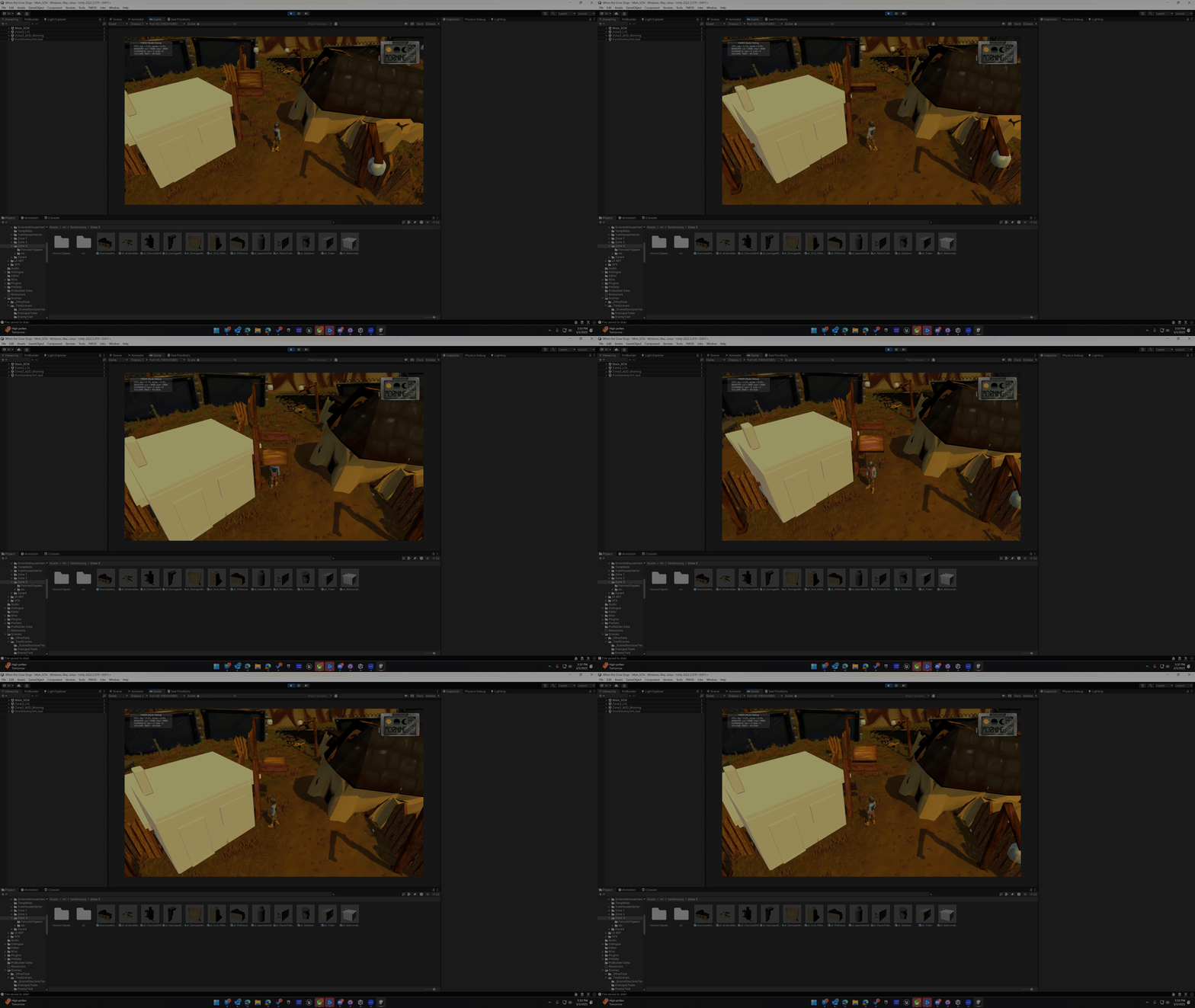
During this month I mainly focused on set dressing and environmental art within levels, adjusting the terrain, adding physics to the sign and some other objects, creating flickering lights, adding set dressing to the Scientist Home and assisting with set dressing in the Rec Center and Zone 2. I also established new lighting for the night scenes across all zones, aiming for a subtle blue to convey the night time while maintaining clarity and visibility.


April
Polish, Playtesting, Publishing.
As we finalized the content within our game, we focused on playtesting, polishing assets and visuals, and optimizing the game. During this time, I thoroughly vetted my scenes, materials, and lighting in both editor and in our builds to make sure everything worked as intended and looked good. However, much of my work as we pushed on to our Steam release was focused on recording and editing footage for our trailers.
Lessons Learned
At first, I found it tough to acclimate working with a team of this size. From having 6 people working in Level Design in the beginning, to getting used to communicating work and revision control updates between my other teammates, to documenting my work and keeping up to date on my tasks: it was all a little overwhelming at first. This came to a head during our first proof of concept showcase.
Leading up to this point, I had been diligently working on a scene to showcase our project's stealth mechanics, using visual scripting to create dynamic locked door mechanics and ensuring the obstacles in the scene best highlighted and showcased how our stealth worked. However, a mistake I had made was not regularly providing screenshots and footage. A few days before my deadline, I pushed my updates to the main project via a pull request, let my leads know, and continued onto other tasks.
However, when we presented our proof of concept, the scene we used to showcase stealth was a completely different one. Instead, the build used a placeholder scene our programmer had used for playtesting the mechanic. Since I had merged the changes a few days before, but the leads weren't familiar with how it looked like exactly, the scene my work was in was overlooked when building. Our revision control workflow was reorganized so no updates could be merged without our leads reviewing and approving them first, and I committed myself to more rigorously document my work, changes, and continuously check in with leads for feedback, notes, and approval on my work. It was a valuable lesson in the importance of regular communication and feedback.


The player had to press a button on the other side of the map, then sneak past the enemy to press the purple button here. The door turned green then swung open, and the player could walk through to load into Zone 4.
Conclusion
When the Crow Sings marks the largest project I've worked on thus far, with the largest team I've worked with. My time on this project been an invaluable lesson in teamwork, communication, time management, work ethic, and honing my creative talents and skills. I'm proud of the work I've put into this title, and the team I've accomplished that work with. I look forward to future experiences working on larger projects with larger teams, and I'm grateful for what I've learned from working on When the Crow Sings.

The finalized layout for Zone 3.
